
Does Learning Math Please God? (e.g., the Area of a Circle?)

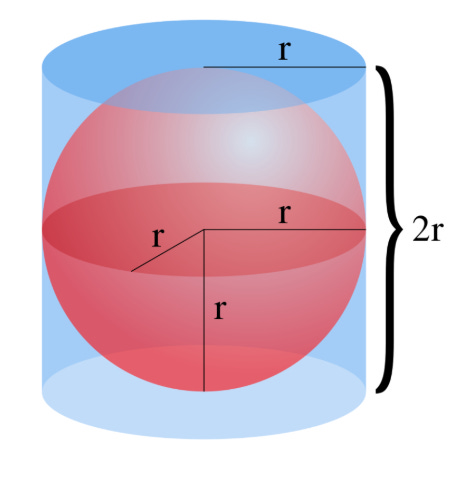
Last Friday I was telling my class how Archimedes was so proud of one of his theorems that he arranged for his tombstone to have a carving of a sphere within a cylinder.1 Archimedes also discovered (probably) that the formula for the area of a circle2 is Area = Pi*Radius*Radius, or “Area equals Pi R Squared” or “A = πR^2” as you may remember it, Pi being a number equal to about 3.14.
Was God pleased that Archimedes discovered that formula? Yes, I think. God made Man and put him on Earth for some reason, and it makes sense that He put him here to exercise the abilities He endowed him with, including reasoning.3
Of course, Archimedes’s discovery was of something God already knew. God Himself created a universe in which Area = Pi*Radius*Radius. In Wagner’s Ring Cycle, the god Wotan can’t get back the Ring, so he sets up the birth of the hero Siegfried in the hope that Siegfried will kill the dragon Fafnir and get the Ring back for him. (To be sure, it doesn’t work out, and in Gotterdammerung the whole world burns down. No wonder Hitler liked it.) The real God, Jehovah, is not like Wotan. God didn’t need to create Man to do things He couldn’t do, like discover mathematical formulas (is Terry Tao, Wotan’s new math-nerd Siegried?).
But I think God liked it when Archimedes discovered the circle formula. He liked it in the same way I liked it when my baby grandson Luke discovered how to smile, or when my two-year-old granddaughter Eleanor discovered how to recognize a chrysanthemum— and how to say it, which was more difficult, not to mention its spelling, which I got wrong when this article was first published (—but nobody pointed out the error to me, either).
Archimedes was representing Man as the first discoverer of that formula. Possibly somebody discovered it earlier in Alexandria but wasn’t as famous, and so his discovery was lost. Somebody in China discovered it independently later—Lin Hui, 400 years later. I think all three discoveries would please God. Equally? Maybe. And even though the discovered were not Christians, this all happening B.C., and may have been evil men? Yes— they were carrying out one of the functions for which God created Man, and which are part of why Man is in God’s image.
That is all very well, but most of can’t discover new mathematical theorems. In fact, hardly anybody can. And of those who can, most of their theorems are boring and useless.4 As someone said of a paper he was reviewing, “This paper has much that is new and interesting. Unfortunately, what is new is uninteresting, and what is interesting is not new.”5
But what most of can do is rediscover old theorems, or learn them from a teacher. And that may be just as good. God was pleased when the childlike Archimedes discovered A = pi*R-squared, and He is pleased when the literal child Sammy learns it. Which is more pleasing is hard to say, especially if Sammy is a slow child for whom learning the formula is a greater accomplishment than Archimedes’s initial discovery.
This is comforting to me. I have high ability, though more in verbal subjects than math. I feel guilty for not using my ability to create more new things. But perhaps I can please God as much by learning old things or by teaching them.6
And so, being a teacher may have as much value, in God’s eyes, as being a discoverer. It may—or may not— comments welcomed.
Anyway, being a teacher has some value, so I will teach you the A = pi*R-squared formula.
Haven't I already done it in this very article, several times?
No.
I’ve told you the formula several times, but I haven’t taught it to you. It is good to know the formula, even if it is just memorization, but I would like to teach you why it is true.
Let’s start with the fact that all circles have the same ratio of circumference (distance around the circle) to diameter because they all have the same shape. We call this ratio “pi”. Pi is usually taught as a number that is approximately 3.14159, but in fact its definition and exact value is circumference over diameter of a circle. All circles have circumferences that are about three times the length of their diameters. And that means every circumference has length C = 2*pi*r, because 2 times the radius is the diameter. (Yes, I rearranged the equation pi = C/(2*pi) here; if you don’t trust how I did it, think a bit )
Look at the circle with radius r in Figure 2 below. We’ll cut it into 16 blue and yellow pizza slices. (Blue and yellow are rather unappetizing colors for pizza, but this is the image I found to paste here.) The idea of the proof is that if we can cut up a circle and paste it back together as a rectangle, then we know the area, because the area of a rectangle is length times width. So we need to figure out how to cut it up and rearrange it into a rectangle.
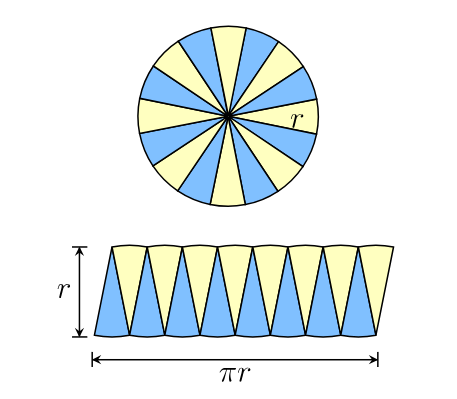
The picture shows how it’s done— sort of. We alternate pizza slices between pointy end up, and crusty-end up. Since you are reading carefully, you’ll have noticed that I don’t really have a rectangle. The left and right edges are diagonals. Also, the slices don’t have flat crust sides— they’re curved, as anyone who has left his crusts piled up after eating the toppings part of his pizza knows. And I can’t fix that, because it won’t work if my slices aren’t diagonal, and we can’t just trim the round parts off the pizza and slyly drop them into the wastebasket. The roundness of the circle is the whole point!7
But suppose we cut the circle into 32 pieces instead. The diagonals would be closer to straight, and the curves closer to straight. Just “closer to” of course. How about 64 slices? That would fool you visually, though you’d still know it wasn’t perfect. But if you tell me how close you want to be to perfect, so long as it isn’t “exactly perfect”, I can find a number of slices that will get us there.8
Anyway, now that we have a rectangle, all we need is to find its height and length. The height is r, the radius, which is the height of every slice (it’s no use being greedy and trying to find the longest one). The length is— and here is a key step— half the circumference. It’s the length of all the crust edges of the blue slices, and that’s half of the total distance around. The total distance is C = 2*pi*r, you may recall (probably you don’t, but look back a few paragraphs), so half the distance is pi*r. Multiplying the height times the length, we get r times pi*r, which is pi*r-squared. And that’s the area formula we were out to find.
Archimedes used a different proof, one that I don’t like as well because it’s more complicated. He compared a triangle in a circle to a square to a pentagon to a hexagon and kept going that way.
Archimedes’s proof does have one advantage, though: it’s better for understanding why the area of a circle is close to 3*r-squared. In my class, I do a fragment of his proof. First, draw a circle with a square around it, as in Figure 3 below. That square will have area 2r*2r = 4r-squared. Thus, we know the area of the circle is less than 4*r-squared. Second, draw a diameter across it and make a triangle by drawing two lines to the top of the circle from each end of the diameter (what’s colored in gray in Figure 3). Triangles have area (1/2)*base*height, so this triangle will have area (1/2) (2r)(r), which equals 1*r-squared. Two triangles like that fit into the circle (we could draw one in the bottom half of the circle as well as the top half), so we have a lower bound on the area of the circle— 2*r-squared.
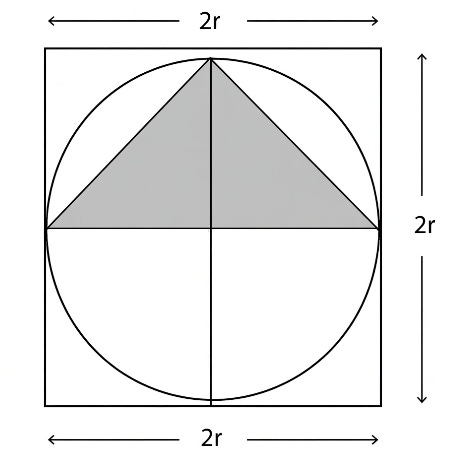
Thus, the area of a circle has to be something between 2 and 4 r-squared— something like
Area = 3.14159 radius-squared
[See also “Pi, part 1: Pi Day Friday”]
Footnotes
It’s not known which cylinder-sphere formula Archimedes was so proud of. He showed that the surface area of cylinder was 50% more than that of the sphere (and exactly the same if you don’t count the circles at each end of the cyclinder). He also showed that the volume of the cylinder was 50% greater. Both are remarkable facts.
My friend CC reminds me that I’m being sloppy here. In math, if you’re being careful, you distinguish between a circle and a disk. A circle is the line looping around. Since it’s a line, it’s one-dimensional and has zero area. All it has is length. A disk is the area within the circle (perhaps including the boundary; I’m not sure). The disk is two-dimensional and does have area. So when I talk about the area formula for a circle, I’m using the imprecise everyday definition of a circle, which doesn’t distinguish between the boundary and the interior, and we really are meaning the area of the interior, the disk.
One might say, “The Westminster Confession of Faith says that God created Man to glorify Him.”
It pleased God the Father, Son, and Holy Ghost, for the manifestation of the glory of his eternal power, wisdom, and goodness, in the beginning, to create or make of nothing the world, and all things therein, whether visible or invisible, in the space of six days, and all very good
That’s true. But what glorifies God? One things that glorifies God is for Man to use the abilities God gave him well, to be a credit to his creator, and to be grateful to him as to a father.
Well, almost useless. In any scholarly field, and any field of industrial research too, what most people do turns out to be useless, but we have to have lots of useless work in order to achieve the valuable discoveries, because you can’t tell in advance which is which. I’m afraid my one math paper, which I could write because I had a mathematician co-author hasn’t taken off like Area Equals Pi R Squared. Still, it does have a pretty picture.
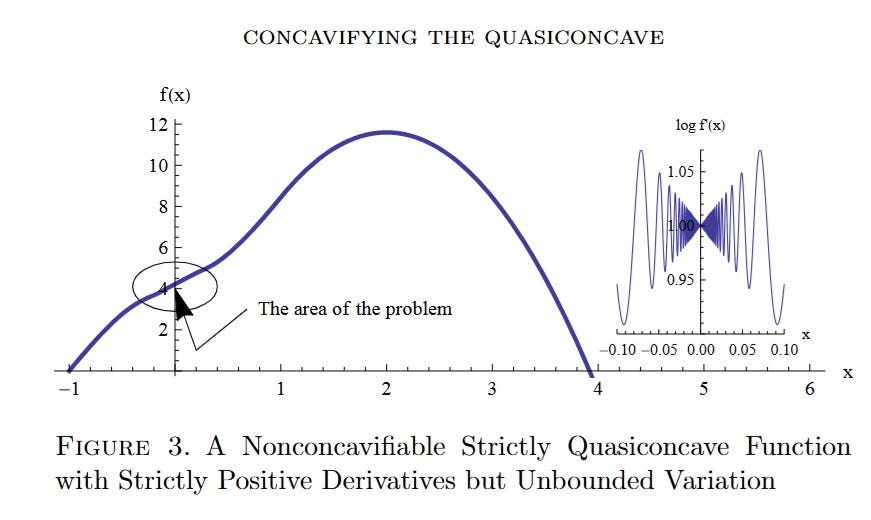
Christopher Connell & Eric B. Rasmusen, “Concavifying the Quasi-Concave,” Journal of Convex Analysis, 24(4): 1239-1262(December 2017) We show that if and only if a real-valued function f is strictly quasi-concave except possibly for a flat interval at its maximum, and furthermore belongs to an explicitly determined regularity class, does there exist a strictly monotonically increasing function g such that g of f is concave. We prove this sharp characterization of quasi-concavity for functions whose domain is any Euclidean space or even any arbitrary geodesic metric space. http://rasmusen.org/papers/quasi-short-connell-rasmusen.pdf or in the longer working paper draft with more explanation, http://rasmusen.org/papers/quasi-connell-rasmusen.pdf
A variant joke: “This paper has new and valid results. Unfortunately, which is new is incorrect, and what is valid is already well-known.”
A theological point: My eternal salvation does not depend on pleasing God. It is His decision, since I’ll certainly sin a lot and any good deeds won’t be able to make up for it. Again, think of the practical insignificance of a child’s pictures and school performance. Still, I would like to please God, whether I am damned or not.
When I teach this, I have the students cut out two circles, from pink and blue paper, and then cut each into 6 slices (instead of 8, to save time— 4 will work too). Then the rectangle of them taped together is twice the area of a circles, but we get the same formula in the end after dividing by two. And they have something pretty to show their parents. Math art.
This is the basic idea of calculus— the limit as a number goes to infinity. If you’ve suffered through epsilon-delta proofs in calculus, I’ve made you suffer again just now. Basically, if you give me an epsilon closeness, I can find a delta number of steps to get you there, for an epsilon greater than zero that you might choose. Think of that the next time you eat your anchovies.
Reminds of a moment in Chariots of Fire I often think about: Eric Liddell says, "when I run I feel his [God's] pleasure. To give it up would be to hold him in contempt."
Eric--ever read Carl Sagan's novel, Contact? God and mathematics figure into it as an extraordinarily elegant subtheme. I highly recommend it.