
Fun with Infinity


As you may or may not know, dear reader, I write about more than politics. I teach 7th grade math, and I was telling my students that there are certain philosophic topics that are still confusing to professional philosophers but so simple enough to state that children can discuss them productively. One is the Liar’s Paradox, which is nice for a church school because Paul alludes to it in his letter to Titus.1 What “infinity” means is another. In this Substack I’ll talk about some ways to attack infinity.2
1. Think of infinity as a process, not a number
The symbol for infinity is ∞. The fact that in the 1600s John Wallis invented a symbol for it can deceive you. It isn’t like pi, π, which is the value of the diameter of a circle divded by its circumference, which is a number close to 3.14159. Think of infinity as a process, as a story, not a number. For example, when I say that I want to talk about all the numbers from 5 to ∞, and write the interval [5, ∞), what I really mean is that I want to talk about all the numbers starting from 5 and going up as far as you could ever talk about and beyond.
Euclid’s postulate for this was that the geometer can draw a straight line as far as he wants and he’ll never run out of table space. In the same way, when I say to add up the numbers from 1 to infinity, I mean you need to keep adding forever. Every infinity is a story of someone having to something forever and still not getting to the end. Often, though, it means doing something forever and what you keep getting closer and closer to but slower and slower.
Since infinity is not a number, you can’t do arithmetic with it. Suppose you tried. You’d get ∞ + 61 = ∞. But if that’s true, then it follows that ∞ + 61 - ∞ = ∞ - ∞, and then 61 = 0, which is stupid. So you can’t do addition, and subtraction has the sample problem.
How about multiplication? Well, ∞*61 = ∞, but then ∞*61/∞ = ∞/∞ and then 61 = 1, which again is a stupid result. Doing exponentiation, taking square roots, trying sines and tangents, and so forth won’t work either. They won’t work because ∞ is not a number, it’s a process. So don’t treat it as a number, as something you can add and multiply.
2. Infinite Addition of Numbers Can Add Up to Less than One
Someone on Twitter posted,
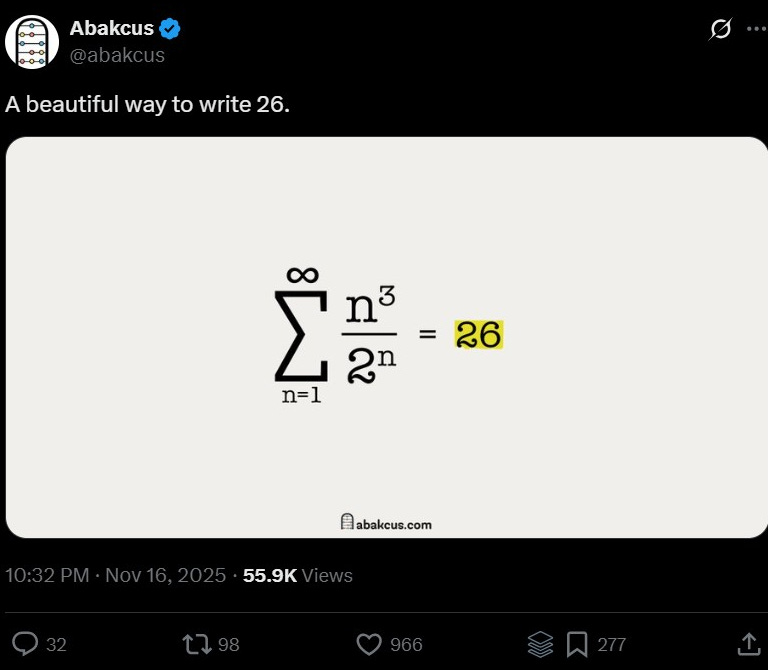
His assertion is correct, though I won’t go into the proof.3 I used this tweet to give the students an example of the summation sign, the big sigma, which I had shown them recently. I didn’t calculate the various terms of it in advance, a mistake on my part. The first few look like this:
Oops! I’d expected the terms to start big and then decline. But these numbers are increasing. It looks like the sum should be infinity— that is, it will just keep getting bigger forever. Nonetheless, having them calculate this on the board was good, because it reviewed exponents and decimals, and I could ask one student to compute each of the three terms.
But wanted to show that the sum wouldn’t be infinity. I said “OK, let’s skip all the way to n = 10.” I went over to my computer, because the arithmetic gets hard. The students charged ahead, though, and rushed the board to try to calculate it. All three arrived at the right answer at the same time, though one had 1056 first instead of 1024. And this actually is a good calculation to know in the computer age, since 2 to the 10th power gives you the size of a kilobyte, which is not exactly 1,000. So:
Well, the n =10 term is smaller than 2 or 3.375, but it’s still pretty big. How about n = 20?
That’s better. The extra terms get very small by the time you’re up to n = 20. It becomes plausible that as you keep adding terms, the sum of them all grows more and more slowly and gets really close to 26. The sum started by rising from .5 to 2.5 to about 6, to something bigger, but it starts slowing down, and the additions after n=20 are tinier and tinier.
This, of course, is experimental math— “scientific math” as I like to call it. Science works by induction, math by deduction. The way an engineer or physicist would approach it is scientific. He wouldn’t just pick n = 1,2,3,10,20 like I did. He’d collect more observations. And my students know how to do that. Python! The computer language.
So let’s do that. Here is a Python program to do it. I’ll show you how I did it in class, which will be helpful for those of you who have never done computer coding.4 First, I showed them how to make the computer give you a given term— n = 20 here:
print("hello world")
n=20
x = n**3/2**n
print(f"if n = {n} then x = {x}.\n ")
I always start with something like “2+2” or “print Hello World” with computers, just to see if it’s working right The output is
hello world
if n = 20 then x = 0.00762939453125.
We tried a bunch more numbers. Anya had the good idea to try to figure out at what point the x’s started getting smaller, and we could do that. But then I showed them how a for-loop can replicate the Sigma summation sign:
print("hello world")

sum=0
for n in range(0,20):
    x = n**3/2**n
    sum = sum + x
    print(f"if n ={n} then x = {x:.2} and sum = {sum:.4}.\n")
The output is
hello world
if n =0 then x = 0.0 and sum = 0.0.

if n =1 then x = 0.5 and sum = 0.5.

if n =2 then x = 2.0 and sum = 2.5.

if n =3 then x = 3.4 and sum = 5.875.

if n =4 then x = 4.0 and sum = 9.875.

if n =5 then x = 3.9 and sum = 13.78.

if n =6 then x = 3.4 and sum = 17.16.

if n =7 then x = 2.7 and sum = 19.84.

if n =8 then x = 2.0 and sum = 21.84.

if n =9 then x = 1.4 and sum = 23.26.

if n =10 then x = 0.98 and sum = 24.24.

if n =11 then x = 0.65 and sum = 24.89.

if n =12 then x = 0.42 and sum = 25.31.

if n =13 then x = 0.27 and sum = 25.58.

if n =14 then x = 0.17 and sum = 25.74.

if n =15 then x = 0.1 and sum = 25.85.

if n =16 then x = 0.062 and sum = 25.91.

if n =17 then x = 0.037 and sum = 25.95.

if n =18 then x = 0.022 and sum = 25.97.

if n =19 then x = 0.013 and sum = 25.98.
So the sum is pretty close to 26 even when n = 19, and it is plausible it will get closer and closer to 26— remember how infinity is a process?5
Anya was skeptical. Properly skeptical. We’re adding an infinite number of items. How can it not come out infinite? If we add an infinite number of things, it should come out infinite no matter how small each item is. What’s the trick?
This is a real paradox. I explained that if the things kept getting smaller and smaller, maybe adding them would never reach infinity. I was very proud of Anya, because she not only caught the point, but then said “Oh! I see,” and gave a better example than I was intending to give to her a minute later. She wrote on the board
.008
.0008
.00008
-----------------
.00888
She had figured out that if we keep on adding 8’s at longer decimal places, we could add them forever and they’d never add up to 1. We would just get 0.00888888888888 . . . (I told her to tell her clever older brother, who’d been in my class a couple years earlier and would be proud of her.)
What I was going to show her is the series below, where we add up the squares of a fraction an infinite times and the sum turns out to equal 1.
so, subtracting V/2 from both sides, we get,
That isn’t as good as Anya’s example, but it illustrates a standard algebra trick for figuring out infinite sums. The “26” sum is figured out using essentially the same trick. If the fractions get small enough fast enough, their sum is finite. But they do have to get smaller than as they keep getting added to your sum. For example, the sum 1/2 + 1/3 + 1/4 + 1/5 + 1/6 + . . . has terms that get smaller, but NOT fast enough, and that usm actually goes towards infinity. If I had 12th graders, I might ask them to show it scientifically.6
Footnotes
“All Cretans are liars,” said the Cretan. Is he lying?
If Cretans are liars, he would be telling the truth when he says “All Cretans are liars,”-- which contradicts his being Cretan. If Cretans aren’t liars, he would be lying when he says that all Cretans are liars, so he would be a liar.
The Cretan philosopher Epimenides of Knossos (circa 600 BC) is credited with the original statement. Paul alludes to it in his letter to Titus.
“One of themselves, even a prophet of their own, said, The Cretans are alway liars, evil beasts, slow bellies.” (Titus 1:12)
The generalization is, of course, false. I have a couple of papers with a Cretan, Professor Emmanuel Petrakis of the University of Crete, and he is truthful. In fact, he proved a conjecture I had about mean-preserving spreads.
The Learning Curve in a Competitive Industry. (with Emmanuel Petrakis, and Santanu Roy), The RAND Journal of Economics (Summer 1997) 28: 248-268.
Emmanuel Petrakis & Eric Rasmusen, ``Defining the Mean-Preserving Spread: 3-pt versus 4-pt,’‘ pp. 53-60 of Decision Making Under Risk and Uncertainty: New Models and Empirical Findings , edited by John Geweke. Amsterdam: Kluwer, 1992, ISBN: 0-7923-1904-4.
I don’t recommend The Infinity Wars, by the way. It’s stupid. To be sure, it does illustrate infinity. Marvel characters can never really be killed off, and the childish movies will go on forever unless public taste improves.
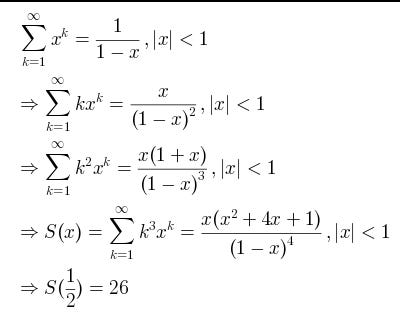
My geometer friend Chris Connell got excited by this at our church small group and figured out the proof in his head, realizing it was in the general class of series’s of squared stuff. As I say later, the key trick is the one I use near the end of this substack. Here is a proof from Twitter:
How many members of the American Establishment elite have never done any programming whatsoever? I’d really like to know. By “programming” I mean “typed in a bunch of computer commands and pressed a button to see if it works”. I hope my non-elite 7th grade girls end up as your overlords someday.
Why does the output only go up to n = 19? Because of that pesky Python feature of not including the upper number of a range. The code asked for “in range(0,20)”. If we wanted to include n = 21, we’d have to write “in range(0,21)”.
My actual homework was to tell them to use Python to compute for n = 1 to 20 the sum of the following two equations. Readers, you too can do this, since if you read footnotes you must be pretty smart. Go to Codabrainy to do Python. At least try to print("Hello World"); it will give you a tiny thrill when it works. The input needs square quotes: " not “.
Fascinating, seeing infinity as a process, not a number, realy makes me think of training AI models where the learning path feels truly boundless.