
Name and Shame--Right, or Wrong?

Two weeks ago I wrote a Substack titled “Who Hired the Ridiculous Jason Arday at Cambridge? I Have the Names.” Even then, it was obvious Jason Arday was a complete liar who invented data and plagiarized text. The point of my Substack was that now we should go on to ask why Cambridge University hired him. Many people ask that, but I also made the point that though as a legal matter, the nonprofit corporation Cambridge University had hired, it was people who made the decision, and I named the people. Moreover, I included their photos, paragraphs on their background, and their email addresses. I said I would write them, which I did, and I asked my readers to also. The Substack got over 45,000 view.
Was I being mean? Was I piling on? Later Professor Arday resigned and committed suicide, but I wasn’t talking about him, but about people like Sally Morgan, Sonita Alleyne, and Hilary Cremin who hired him (those are the three most important). My hope is that severe moral pressure will be put upon them and that they, too, will resign in shame. I hope they do not commit suicide, but that possibility does exist.
The Substack got 257 comments, many of them good. One of the best and most negative was from Professor McMillan of Georgia State University:
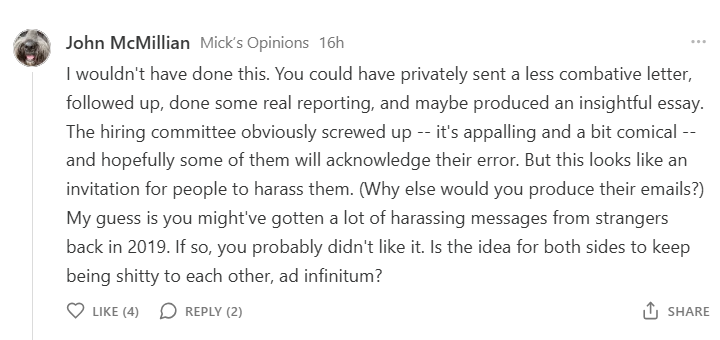
I like this comment because it gives reasons for why the author disagrees with me and it also is constructive criticism: it says what I should have done instead (make my letter less combative and send it privately, so as not to embarass them). He refers to my personal experience. I was cancelled twice, in 2003 and 2019, with distinctly unpleasant coverage in the national and international media. I did get a lot of messages from strangers. In 2019 I created a website— my standard advice for controversies— and I created pages of encouraging and negative emails. Here are some of the best negative ones: 1
SO sick of you stupid small minded boomers! WHEN WILL YOU DIE hopefully soon
why u so ugly :/
Wearing my #FemaleGenius hoodie to support the @IUBloomington Women in Business group, who sold them to protest the racist, sexist, and homophobic stances of professor Eric Rasmussen (@erasmuse).
You’re stupid...There isn’t any reason to argue with someone like yourself. Racist, Bigoted and Homophobic??? Why are you even still employed. Oh yeah, you’re an OLD WHITE racist, bigoted and homophobic dude.
Hope you die of testicular cancer
I’m amazed you were given your highschool diploma, let alone a PhD and a job.
Stop hiding your sexism behind you’re faith. You are a bigot plain and simple
It was striking how well written and full of content the encouraging emails were, and how almost all of the negative emails were pure insults, many of them with foul language. I didn’t really mind the negative ones, since they were from people I didn’t know and whose opinion I didn’t value, and almost always (always?) anonymous. What the emails to me and my Substack and emails to the Adrayists illustrate, though, are two of three kinds of messages:
Messages that send along new information or request new information. For my Substack I googled around for information; my emails were requests for more information. The Guardian’s first article on Adray is an example too: they checked upon the pig’s head story.
Messages that pass along existing information to people who haven’t heard it yet. This is the role that the media and some Tweets play. Newspaper readers had not even heard of Jason Adray, so newspapers would create stories out of information from Tweets and what other newspapers said.
Messages that are purely for the emotions of the sender or the receiver. That’s what the 2019 negative emails to me were. They contain no information except “I don’t like you” and “I am part of the Dislike tribe and like saying the same thing in unison with my friends.” This second is “piling on”. Message senders are not trying to say anything new; they are just saying, joyfully, “Me too” so they can feel part of a group. When I explained this concept to my teenage daughter, she understood it immediately. “It’s like when a group of girls hates on someone and everybody says bad things about her.”2
This does not really get a Professor McMillan’s point, though. He would grant that the first two kinds of messages are useful, but would want them phrased more mildly, and with less attention to the individual. Perhaps something like the letter of Professor Matthew Braham of the University of Hamburg:
I have taken your initiative Eric, and wrote to all these electors as well, pointing them to the Bayreuth affair that I posted elsewhere. Here is the text of my letter:
Dear Colleague,
It has come to my attention that you may have been involved in the appointment of Jason Arday. In this regard, that appointment has brought Cambridge University’s reputation into disrepute. The following X-feed had nearly 0.5m views this morning:

The affair is harming the entire academic community.
In this regard, the affair took me back to Bayreuth in 2011, when a regional Bavarian university found itself at the centre of a national crisis. Karl-Theodor zu Guttenberg — Defence Minister, poster boy of the CSU, the Bavarian half of Merkel’s then coalition — was exposed for plagiarising his doctorate. I watched my own university blink. It stripped the degree, but on narrow administrative grounds, declining to find that the he had deliberately deceived. The technical route minimised the damage to him.
What saved Bayreuth’s integrity, however, was that its own professors refused to accept this. Oliver Lepsius, the constitutional lawyer who then held the Bayreuth chair of Guttenberg’s own supervisor and has since moved to Münster, said publicly what the institution would not: “We feel deceived. We were taken in by a fraudster.” The dam broke there. Pressure from the professoriate built through the following weeks, and my friend and colleague Rainer Hegselmann, professor of philosophy and the driving force behind the Philosophy & Economics degree that made Bayreuth internationally known, wrote to the University President: “by such finesses the university effectively makes itself the accomplice of a fraudster” (“Komplize eines Betrügers”). The university’s own commission concluded in May 2011 that the deception had indeed been deliberate. It did not get there on its own.
The lesson for Cambridge is that no institution has ever protected its reputation by protecting misconduct. Deference to a powerful politician and deference to a high-profile professor produce the same result: the erosion of public trust, and with it the value of every degree the institution confers. Bayreuth is no Cambridge. But when the moment came, its professors did their duty.
Sincerely,
Matthew Braham
My answer to Professor McMillan, though is the business idea of Making Someone Responsible. If a committee makes the decision to produce a new product, who do you fire if it turns out to be a bad idea like the Nike sports shoe company ads that drove it’s stock price down 80% by talking about patriarchy, featuring homosexuality and chubby girls, and mocking its classic older ads about heroism?(“Nike’s End of Men”, Strauss Substack, 2021). It is better management practice to make one man responsible at the time of the decision. (A bad practice is to choose the responsible man after failure— the “Fall Guy” strategy.) This has two benefits. First, the one responsible will put out his full effort, to avoid getting fired and to obtain promotion. Second, even if effort is not the problem, this reveals his incompetence or competence, and he can be fired or promoted for those things. Mark Twain points this out in his kind words about French railroads:

Twain’s story point out that not all is lost even if it is not clear who had responsibility. Even then, the organization can fire somebody at random. Knowing of this possibility, everyone on the committee will exert full effort. This was actually the idea mathematically modelled in my first published paper, in 1987.3
We know that certain people bear responsibility for hiring Jason Arday— Sally Morgan on the hiring committee and Sonita Alleyne, Master of Jesus College, for example, and there may have been members of the hiring committee who dissented from its decision, though Education Faculty head Hilary Cremin said it was unanimous.4 So the best thing to do is name them all and see who comes out of the shadows to say he’s not to blame.
In controversies like this, everyone wants to run away and hide. The trick is to make it scarier to hide than to come out and talk. This is much like every army since civilization began: it has to be scarier to run than to stay and fight. Usually, either all stay or all fight. Examples of each are professors at Ave Maria Law School and Widener Law School around 2011. At Ave Maria they all signed a letter against the Dean; at Widener they let him persecute a colleague without a peep. I tried writing to the Widener faculty threatening to publicize their cowardice, but I can’t find my records on that.
This leads to a piece of practical advice, one I taught the business students in my regulation class. When you are frustrated with a bureaucrat, don’t shout or grumble, though appeals to his good nature might possibly work. Instead, calmly get his name and the name of his superior. Do not say what you will do with this information. And do not get the information somewhere else— off the website, for example. You want that person to bear the responsibility for his decision, and to know that he bears it.
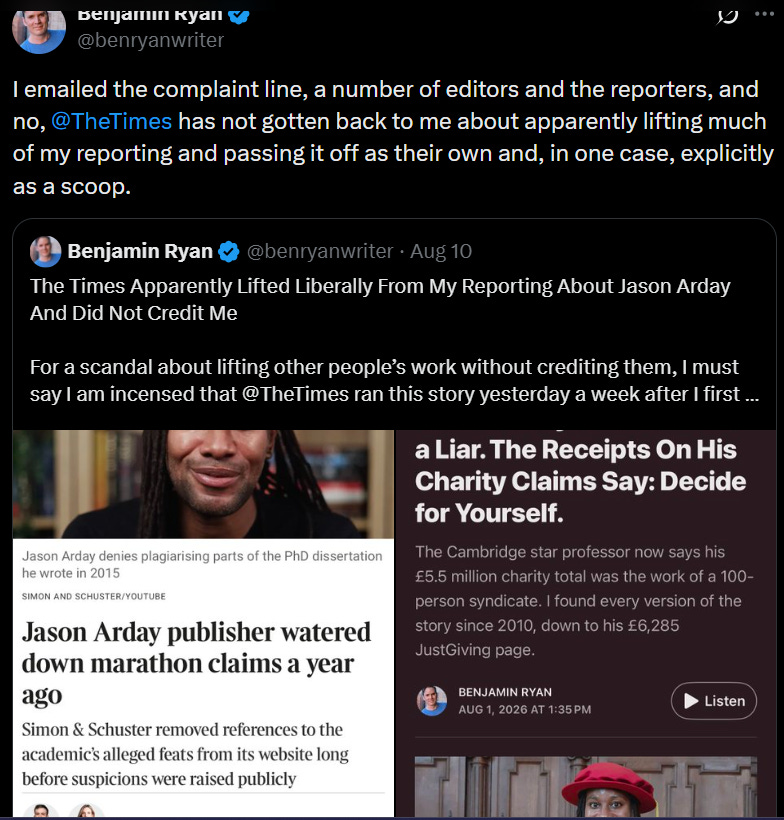
Another idea I give you for inspiration is that targeting the guilty individual allows you to use a sort of judo combat, using information that even an otherwise powerless person can find to throw a giant organization to the floor. Look what Nathan Cofnas did to Cambridge University. Journalist Carole Cadwalladr describes this in the case of one of Professor Arday’s students, though she is very unhappy that marginalized people are thereby empowered against giant universities. From “A Digital Lynching: A practical guide for individuals and organisations when the mobs gather”:
The article the Times paid to algorithmically amplify? It’s an anonymous account from a lone student who complained Arday gave her 70% for an essay when she felt she deserved 75%. It was published in UnHerd then republished in the Telegraph and Times and then pumped out to hundreds of thousands of people across different platforms.
This is what surveillance capitalism has given us. A recursive feedback loop that sees an ad team select a publication’s most clickbaity articles that leads to an increase in traffic that signals the “public interest” aka appetite to publish more articles. It’s a money machine.
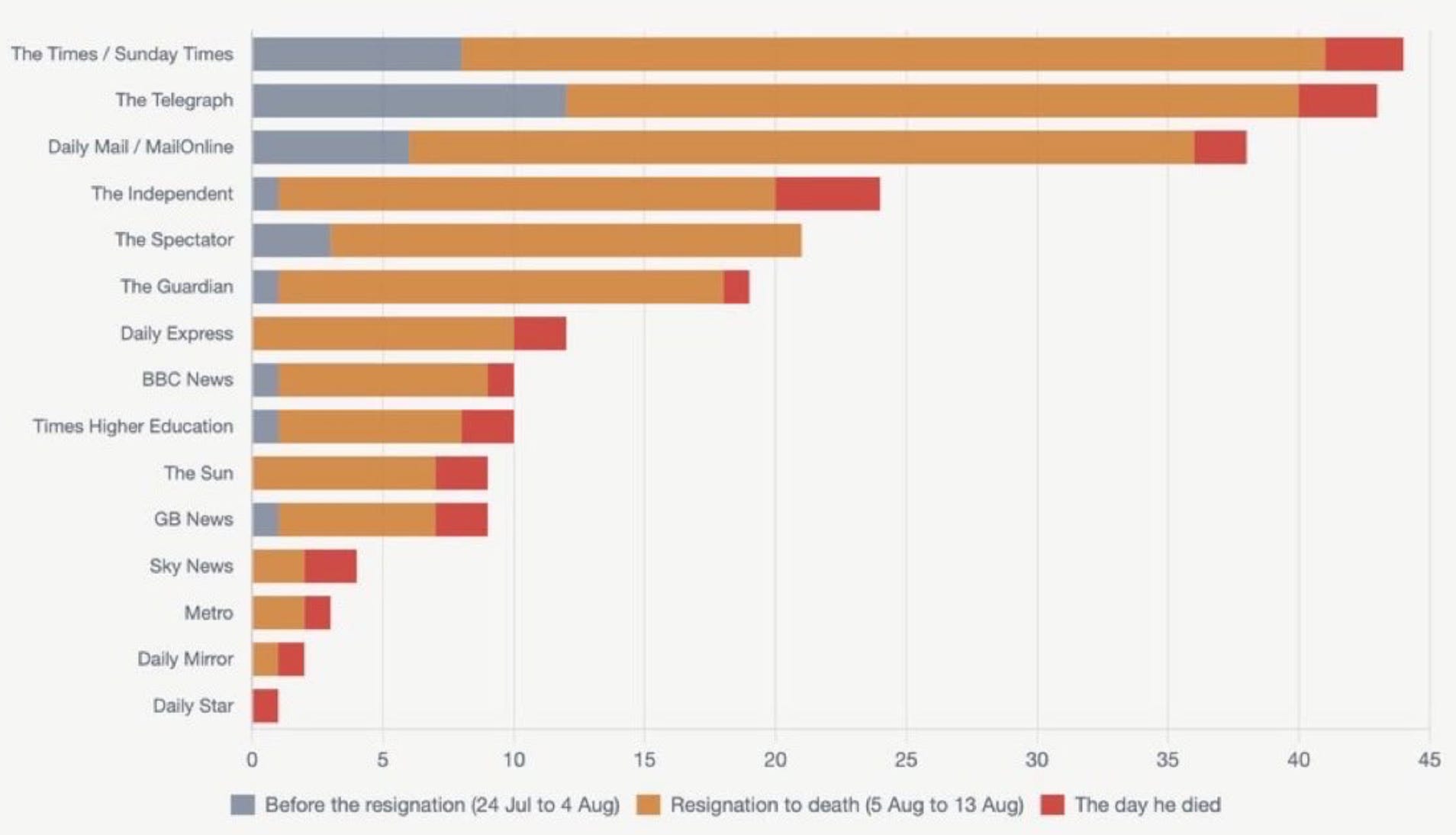
She exaggerates the role of the corporte media, however. Her Substack includes a very good chart showing how the British media—even the supposedly conservative part— was extremely unwilling to cover the Adray story until their hand was forced by X and Substack— at which point they went to town with it, not crediting, however, the work of the unpaid amateurs who actually found out the facts of the story.5
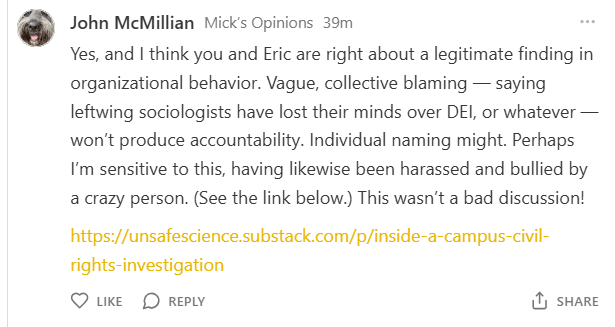
I have written too long, perhaps, but let us come to a happy ending. Professor McMillan, who criticized me so much in the Reply at the start, continued a discussion with me in the comments, and Vrednaya Shrul two other people came into the discussion too. Professor McMillan told us he’d been the target of a groundless investigation by a psychotic colleague (not his words) and harassment campaign. We had a good discussion in the comments and we all learned something. That’s what social media ought to be about.
I6 have7 footnotes8 for raw material:9
Footnotes
I’ve suggested to Nathan Cofnas, whose Substack broke the Arday story, that he post his own set of death threats on the Web. He had 15,000 people in London howling for his condemnation (dare I say howling for his head?) the other day.
Two other message purposes are:
To show how smart the sender is.
To show how witty the sender is, or to amuse the recipient.
“Moral Hazard in Risk-Averse Teams,” RAND Journal of Economics, 18: 428--435 (Fall 1987). Holmstrom (1982) has shown that a non-budget- balancing contract induces a team of risk-neutral agents to choose the first- best effort levels. This is not generally true when agents are risk averse. Furthermore, a “massacre” contract, which punishes all but one agent when the outcome is low, can attain the first best over a wider range of parameters than any other budget-balancing contract. http://rasmusen.org/published/Rasmusen_87.RJE.teams.pdf
Bengt Holmstrom won the Nobel Prize, and this is his most famous article.
That she said the vote was unanimous doesn’t mean it was. At one opening fall faculty meeting, Jeff Prince, the weasel who was Chair, said that hiring a certain assistant professor was unanimous. I had strongly opposed the hire, and in fact, if a departmental vote had been allowed by the Chair, I think the candidate would have failed. So I said that the Chair was wrong and it was NOT unanimous. You could have heard a pin drop. The junior faculty looked terrified at this conflict between their seniors.

People value the opinion of their peers. THus, to punish The Times, you need to write to The Telegraph, etc. telling them what The Times did. Judges too. Professors too. Athletes?
Federalist Society and MFSA and AFSA are tyring to gt discussions oing.
Difficult Conversations: How to Discuss What Matters Most by Douglas Stone, Bruce Patton, and Sheila Heen
Your chart on how the national press covered the story is interesting as is how the Socialist Worker covered it. The SWP completely ignored this story until he ended his life. I assumed that they'd got the good sense not to pin their colours to this particular mast but now he's died, they're full of it. This particular story claims that exposing Arday's massive overpromotion, his plagiarism and his huge and fantastic lies are somehow comparable as newsworthy with various professors trying to shag their students. The argument that the Unis covered up these particular crimes because the profs were white seems to ignore the fact that Cambridge tried desperately to cover up for Arday and only acted when his claims of being a visiting prof at other universities was exposed as fiction.
https://socialistworker.co.uk/womens-liberation/how-white-academics-are-protected-by-a-racist-system/
I really like this from Rainer Hegselmann as quoted by Matthew Braham though:
the university effectively makes itself the accomplice of a fraudster
That is the key point. Arday was a fraud. The universities enabled his fraud